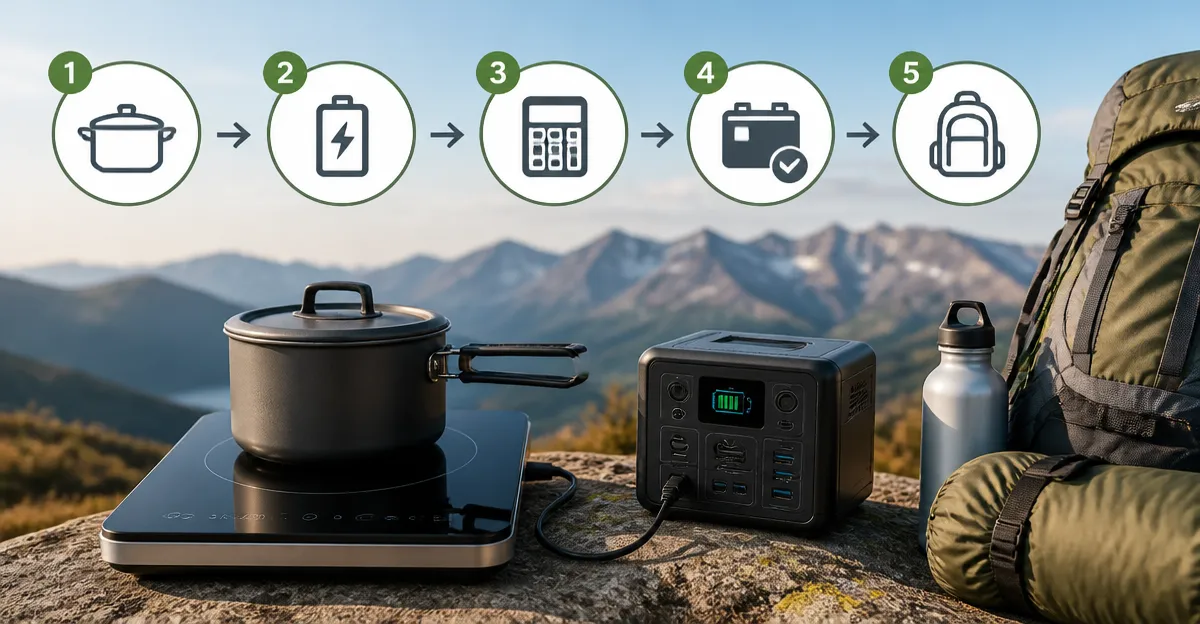
How to Calculate Battery Needs for an Induction Stove While Backpacking: Step‑by‑Step Battery Calculator Guide
Introduction
Backpacking enthusiasts often desire the convenience of an induction stove because it provides rapid, controllable heat without open flames. However, an induction stove draws a significant amount of electricity, and the weight of batteries can quickly become a limiting factor on the trail. This guide explains how to calculate the exact battery capacity required for a given stove, how to translate that capacity into real‑world power‑bank selections, and which products perform reliably in outdoor conditions. By following the methodology, one can avoid under‑powering the stove or over‑packing unnecessary weight, thereby maximizing safety and efficiency.
What You’ll Need
- Induction stove (specifications sheet for wattage and voltage)
- Battery capacity calculator (paper or spreadsheet)
- Portable power source (power bank or portable power station)
- USB‑C to AC inverter cable or appropriate DC output adapter
- Multimeter for verification (optional but recommended)
For the portable power source, the following products are proven to meet the demands of most backpacking induction stoves:
- Nuxgal 50000mAh Power Bank
- OHOVIV 50000mAh Power Bank
- Jackery Explorer 300 Power Station
- Anker 10000mAh Power Bank
Step 1: Determine the Stove’s Power Consumption
The first step is to identify the stove’s rated power in watts (W). Most compact induction stoves list a range, for example 300 W to 600 W. Select the maximum wattage you anticipate using, because this value determines the worst‑case energy draw. If the stove operates on 110 V AC, the power bank must provide an inverter capable of delivering that voltage. For example, a 600 W stove at 110 V draws approximately 5.45 A (600 W ÷ 110 V). Knowing this current is essential for matching the output specifications of the chosen power source.
Step 2: Estimate Daily Usage Time
Estimate how many minutes per day you will operate the stove. Backpackers typically use the stove for meal preparation, which may total 30‑45 minutes per day. Convert minutes to hours (e.g., 45 minutes = 0.75 hours). Multiply the stove’s wattage by the usage hours to obtain watt‑hours (Wh) required per day. Example: 600 W × 0.75 h = 450 Wh. This figure represents the energy that must be supplied by the battery pack.
Step 3: Convert Watt‑Hours to Amp‑Hours for Your Battery Voltage
Portable power banks usually specify capacity in milliamp‑hours (mAh) at a nominal voltage of 3.7 V (the internal lithium‑polymer cell voltage). To compare with the stove’s Wh requirement, convert Wh to Ah at the battery’s nominal voltage: Ah = Wh ÷ Voltage. Using the 450 Wh example and 3.7 V, the required Ah equals 450 ÷ 3.7 ≈ 121.6 Ah, or 121 600 mAh. Because manufacturers round capacities, you will need a power source that offers at least 120 000 mAh.
Step 4: Choose the Appropriate Battery Type
Two categories of portable power are suitable for induction cooking: high‑capacity power banks (≥50 000 mAh) and lightweight portable power stations with lithium‑iron‑phosphate (LiFePO4) chemistry. Power banks are compact and inexpensive, but they provide AC output only through an inverter accessory, which reduces overall efficiency. Portable power stations, such as the Jackery Explorer 300 Power Station, include built‑in pure‑sine‑wave inverters and higher continuous power ratings, making them ideal for longer cooking sessions.
Step 5: Calculate the Required Capacity Using Real‑World Efficiency
Inverters are not 100 % efficient; typical efficiency ranges from 85 % to 92 %. Apply a safety factor of 1.15 to the Wh requirement: Adjusted Wh = 450 Wh × 1.15 ≈ 517.5 Wh. Now convert to mAh at 3.7 V: 517.5 ÷ 3.7 ≈ 140 Ah, or 140 000 mAh. This adjusted capacity ensures that the battery will not be depleted before the next recharging opportunity.
Step 6: Match Calculated Capacity to Available Products
Compare the 140 000 mAh target with the capacities of the recommended products:
- Nuxgal 50000mAh Power Bank – Offers 50 000 mAh at 3.7 V, equivalent to 185 Wh. It can power a 300 W stove for roughly 0.3 hours, but it falls short for a 600 W stove at 45 minutes. It remains useful as a supplemental pack when paired with a larger unit.
- OHOVIV 50000mAh Power Bank – Same nominal capacity (185 Wh) with three simultaneous output ports. It is suitable for low‑power cooking (300 W) or for charging auxiliary devices while the stove runs.
- Jackery Explorer 300 Power Station – Provides 292 Wh of usable energy and a 300 W continuous AC output (600 W surge). This unit alone meets the adjusted 517 Wh requirement only if paired with a solar panel or an additional battery, but it delivers the pure‑sine‑wave output required for stable induction operation.
- Anker 10000mAh Power Bank – Supplies 10 000 mAh (37 Wh) and is intended for charging phones and small electronics. It is not sufficient for cooking but can serve as a backup for communication devices.
For a single‑unit solution, the Jackery Explorer 300 Power Station is the most appropriate because it includes an integrated inverter, multiple output ports, and a durable LiFePO4 battery that can endure thousands of charge cycles. If weight is the primary concern, combine two Nuxgal 50000mAh Power Banks to approach the required capacity while distributing the load across two devices.
Step 7: Connect the Stove Safely
Use a high‑quality AC inverter cable that matches the power bank’s output voltage and the stove’s input plug. Verify that the inverter’s continuous rating exceeds the stove’s maximum wattage. Connect the inverter to the power bank, then plug the induction stove into the inverter. Before cooking, measure the voltage with a multimeter to ensure a stable 110 V (or 220 V, depending on the stove). Secure all connections with cable ties to prevent accidental disconnection while hiking.
Step 8: Test, Monitor, and Optimize
Perform a short test run of the stove for five minutes while monitoring the power bank’s displayed remaining capacity. Note the percentage drop; this provides a real‑world discharge rate that can be used to refine future calculations. If the observed drop is larger than expected, consider reducing cooking power or adding an additional battery pack. Keep the power bank’s LED display visible, as the Nuxgal 50000mAh Power Bank offers a precise 1 % increment readout, which aids in accurate monitoring.
Tips & Pro Tips
- Use a high‑wattage wall charger (≥60 W) to recharge power banks quickly between trips. The Nuxgal and OHOVIV models both support PD 4.0 fast charging, reducing downtime.
- Employ solar panels for extended trips. The Jackery Explorer 300 reaches 80 % charge in 2.8 hours with a 100 W panel, making it ideal for off‑grid recharging.
- Distribute load by powering auxiliary devices (lights, GPS) from the secondary USB ports of the power bank while the stove draws from the AC inverter. This prevents overloading a single output.
- Maintain temperature by keeping batteries out of direct sunlight; extreme heat can reduce capacity and increase safety risks.
- Carry a spare cable for the inverter; cables are a common point of failure on long hikes.
Troubleshooting
Problem: Inverter shuts down during cooking.
Solution: Verify that the power bank’s continuous output rating exceeds the stove’s wattage. If the rating is marginal, add a second power bank in parallel or switch to a higher‑capacity power station.
Problem: Battery percentage drops rapidly after a short period.
Solution: Check for hidden background loads (e.g., LED display on the power bank) and turn them off if possible. The Nuxgal model allows the LED display brightness to be adjusted, reducing idle drain.
Problem: Power bank does not charge while on a solar panel.
Solution: Ensure the solar panel’s voltage matches the input specifications (PD 4.0 or QC 4.0). The OHOVIV 50000mAh Power Bank successfully charges from a 100 W solar panel via its USB‑C input, as reported by users.
Conclusion
Calculating battery requirements for an induction stove while backpacking involves understanding the stove’s wattage, estimating usage time, converting energy units, and accounting for inverter efficiency. By following the eight‑step method outlined above, one can select a battery solution that balances weight, capacity, and reliability. The recommended products—Nuxgal 50000mAh Power Bank, OHOVIV 50000mAh Power Bank, Jackery Explorer 300 Power Station, and Anker 10000mAh Power Bank—provide a range of options from lightweight backup to full‑featured power stations. Armed with accurate calculations and the right tools, backpackers can enjoy the convenience of induction cooking without compromising safety or pack weight.
Products Mentioned in This Guide
Frequently Asked Questions
How do I determine the watt‑hour requirement for my induction stove?
Multiply the stove’s wattage by the number of cooking hours, then divide by the inverter’s efficiency to get total watt‑hours needed.
What inverter efficiency should I factor into my battery calculation?
Assume 85‑90% efficiency for a quality USB‑C to AC inverter unless the manufacturer specifies otherwise.
How many amp‑hours of battery are needed for a typical 2‑hour cooking session on a 150 W stove?
At 12 V, a 150 W stove for 2 h requires ~25 Wh; accounting for 85% efficiency, you need about 30 Wh, which is roughly 2.5 Ah at 12 V.
Can I use a USB‑C power bank to run an induction stove, and what specifications are required?
Yes, if the power bank can deliver at least 150 W through its USB‑C PD output and includes a compatible high‑efficiency inverter.
What safety tips should I follow when using batteries with an induction stove on the trail?
Secure the battery to prevent movement, keep it away from extreme heat or moisture, and monitor voltage to avoid deep discharge.